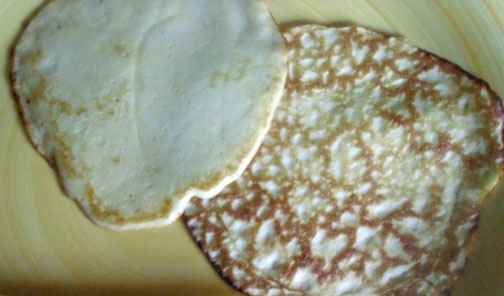
• Grain-free Coconut Crepes

    Grain-free Coconut Crepes

    Last week I got hit pretty hard with a Herxheimer reaction.  A what, you say?

    A Herxheimer reaction (also called a “die-off” reaction or a “Healing Crisis”) “is the result of the rapid killing of microorganisms and absorption of large quantities of yeast toxins, cell particles and antigens.”  (Virgin Coconut Oil).

    Basically what this is saying is that when toxins try to leave the body faster than it can handle, it creates “die-off” symptoms which can vary from person to person.  The symptoms are usually a repeat of symptoms a person already has but they can get worse before they get better.

    But it’s a good thing!  It means your body is actually on its way to achieving a new level of healing.  However, it is difficult sometimes to know if you’re simply reacting to something you ate (in a bad way) or if there is actually a healing crisis going on.

    Read the rest of this entry »

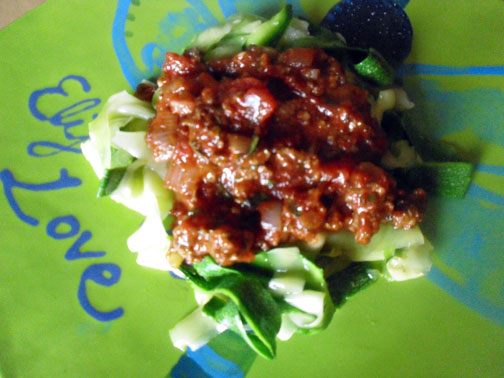
  • Zucchini Pasta Noodles
    Zucchini Pasta Noodles

    tuesdaytwisterThis is my weekly post talking about what’s been twisting and brewing in my kitchen.  It is part of Wardeh’s Tuesday Twister at GNOWFLINS. Check it out!

    It’s been a busy and eventful week!  I have been very inspired and have been experimenting with new and wonderful recipes!  My week started out last Sunday with a renewed inspiration and dedication to creating traditional foods that are very nourishing for the body.  Wardeh’s post about reversing food allergies through traditional foods got me started with this.

    Midweek, I was contacted my someone who had emailed me a few weeks ago asking for help with menu planning for a very limited diet.  The first time she emailed, she was reacting to many foods including all grains, eggs, casein, poultry, and milk.  On top of that, she also has celiac disease.

    Last week she emailed me and told me she had been doing the GAPS diet and program.  She said that it was not only helping with her problems, she was becoming “un-allergic” to foods that had previously upset her.  Her diet is still very limited but she is looking forward to introducing more foods and sounds really good!

    Now, when I hear the same thing twice in one week from two different sources, I feel like “someone” is trying to tell me something!

    I checked out GAPS and was intrigued by what it claims to help people with!  In a nutshell, it aims to heal the gut lining, and therefore helps adults and children with an array of digestive AND mental problems such as:  depression, celiac disease, non-anaphylactic food allergies and sensitivities, autism, ADHD, colitis, obsessive compulsive disorder, Chrohn’s, learning disabilities, diverticulitis, candida overgrowth, and much more!

    I am almost finished reading the Gaps Guide, by Baden Lashkov and will soon be ordering the book, The Gut and Psychology Syndrome, by Dr. Natasha Campbell-McBride, MD.  I am completely fascinated by this diet and program and am really enjoying reading it!  I am still learning so much;  when I am a bit further with it, I will write a more thorough post about it.

    Read the rest of this entry »

  • Soy-free and Dairy-free Cheese

    Soy-free and Dairy-free Cheese

    Soy is one of the top eight most common food allergens.  Yet, soy products can be found in many foods in restaurants, fast food, manufactured breads, cereals, mayonnaise, salad dressings, in non-dairy milk products and many other foods.

    Soy can be hiding in your food under any of the following ingredients:

    emusifiers*
    soy flour
    soy oil
    soy sauce
    tamari
    Bragg’s liquid amino acids
    tempeh
    vegetable gum*
    lecithin*
    soy lecithin
    soy protein
    soy sprouts
    tofu
    vegetable oil*
    vegetable shortening*
    textured vegetable protein (TVP)
    miso
    soy albumin
    soy milk
    soy protein isolate
    soy-based infant formulas
    unspecified sprouts*
    vegetable paste*
    vegetable starch*
    hydrolyzed vegetable protein (HVP)*
    shoyu
    soy beans
    soy nuts
    edamame
    soya
    stabilizers*
    vegetable broth*
    vegetable protein*
    hydrolyzed plant protein (HPP)*
    *  These items may or may not contain soy; the source if seldom listed on a food label.
    Source:  Vickerstackk-Joneha, J. Managing Food Allergy and Intolerance:  A Practical Guide.  1995

    So if you have soy allergies or a soy intolerance, it is imperative that you read labels on foods carefully and ask specifically about the food you are ordering in a restaurant if you’re eating out. For many people, creating all or most of your food at home is the best way to ensure you are avoiding all soy products.

    Read the rest of this entry »

  • shells

    Dreams do come true.  I’ve been dreaming about the ocean and the beach, literally, for the past couple of years.  I was pregnant two years ago and traveling wasn’t very easy so we didn’t go.  And last year, we went to the mountains in California but weren’t able to visit the beach on that trip.  But this year we took our 21 month old toddler to the beach in North Carolina and we had a ball.

    We went with a beautiful family whom we have only recently befriended this past spring.  But with some friendships, doesn’t it seem like you’ve known each other forever?

    My friends have three kids, ages 2, 5 and 8.  So counting all the heads, that made eight people to feed, breakfast, lunch and dinner.  To make things more complicated, Jana and I are both gluten-free and Elijah and I are dairy-free.  So before our trip, we did a little gluten-free and dairy-free menu planning and came up with the following ideas for our families:

    For dinner:

    Turkey Burgers and Sweet Potato Fries (one of my standbys)

    Meatloaf (Made with Grass-fed Beef) and Steamed Broccoli (I used almond meal in place of breadcrumbs)

    Chicken Burritos with Lime Guacamole (I use Food for Life Brown Rice Tortillas for the gluten-free people)

    Lasagna with Ground Turkey (I use Tinkyada Brown Rice Lasagna noodles)

    Pasta with “Cheese” Sauce and Green Beans and Peas (I use Tinkyada Brown Rice Noodles)

    For breakfast:

    Gluten-free pancakes (made one batch with coconut flour and one with buckwheat flour)

    Grain and Gluten-free Apple Muffins (made with quinoa flour)

    Omelets with Mushrooms, Onions and Tomatoes

    Eggs and Toast

    Smoothies

    Fruit Salad

    Lunch:

    Chicken Salad with Celery and Raisins (I would have added chopped apples but they made faces at me when I mentioned this!)

    Sandwiches and other snack items

    Leftovers

    Some kid-friendly tips that I learned on the trip:

    I learned a lot this week about what a lot of parents struggle with daily – how to feed a children new and different foods they aren’t used to.  Luckily the toddlers are not very picky – my little one is used to my “weird” cooking and doesn’t question me about if cheese is real or not.  Jana’s toddler Zack is also a champ at eating unless he’s not hungry.

    Read the rest of this entry »

    Tags: , , , ,

  • Gluten-free pizza crust, tort style

    Gluten-free pizza crust, tarte style

    tuesdaytwister Notes:  I’m having some quirky problems with my website so I am using bullets to separate the paragraphs in this post.  I am also submitting this post as part of the Tuesday Twister Carnival at GNOWFGLINS.  Please visit Wardeh’s site to see all the other wonderful weekly posts.

    • As promised, I am posting a recipe for gluten-free pizza crust.  However, this is a different recipe than the one that I mentioned in my review of premade pizza crusts.  The following recipe is for a tarte style gluten-free pizza crust that I adapted from a recipe in Nourishing Traditions, by Sally Fallon.  I have been slowly transitioning to more traditional methods of preparing and making baked goods, as suggested in her book.   The main step that is added in traditional methods of preparing baked goods is to soak the flour for 12-24 hours in yogurt, buttermilk, or water with lemon juice or apple cider vinegar if you can’t eat dairy products.
    • This extra step (though it takes planning and time) makes baked goods much more digestible than if they are baked without soaking.  Through soaking flours, the process of lacto-fermentation begins, which is a natural process that creates healthy bacteria like the ones in yogurt and traditional sauerkraut.
    • I have to say I’ve been somewhat resistant to transitioning to this new “lifestyle” of soaking flours ahead of time.  I usually end up wanting to make something right before I’d like to eat it, which doesn’t work so well for this process.
    • But after making my muffins, and then this pizza dough, I am becoming sold on this way of preparing baked goods.  And it is mostly due to the way these baked goods make me feel verses ones that aren’t soaked first.
    • When I ate this pizza crust, I didn’t get that “carbohydrate rush” that comes with most baked goods.  Instead, I felt nourished and fulfilled.   My blood sugar remained “stable” and it also felt more like a meal than regular pizza makes me feel.  I didn’t have any digestive upsets from it at all, which I normally have even a little bit of after I eat non-soaked flours, even if they are gluten-free.  On the contrary, I felt like it was nourishing food for my body.

    Read the rest of this entry »

    Tags: ,

  • Dairy-free, gluten-free, soy-free cheese with garden tomatoesI feel like I am somewhat on a quest;  a quest to find food that anyone can eat, no matter what their food restrictions may include.  This is now my second attempt at a recipe for SLICE-ABLE and GRATE-ABLE, dairy-free, casein-free and soy-free cheese.  Unfortuanately it doesn’t cover people with nut or cashew allergies, but hopefully many people can use and enjoy this recipe.

    I actually like it better than my first attempt at slice-able, casein-free cheese.  The first one was a bit flimsy, though it did slice.  And the only way to get it to grate was to freeze it, which was time-consuming and a bit cold on the fingers!

    I found this new recipe in The Real Food Daily Cookbook by Ann Gentry under “Cashew Cheddar Cheese.”  I made some adjustments – such as replacing the soy milk with almond milk and canola oil with olive oil.  I also halved the recipe completely because it called for 2 ounces of agar agar.  At around $7 or so an ounce of this seaweed, I decided to just half the recipe to see if I even liked it before spending so much on the agar agar!

    Because this recipe uses agar agar, it is suitable for vegetarians and vegans.  The previous recipe called for gelatin, which I’m not too fond of either.

    The other great thing about this new recipe is that the cheese can be grated without freezing it!  See below:

    dairyfreeshreddecheese

    And yes, it can be melted after it hardens, or you can use it as a melted cheese when you first make it.

    As for the flavor, I thought it had a nice flavor, however I may use a tad more garlic and onion powder next time and maybe a bit more nutritional yeast.

    Read the rest of this entry »

© 2010 Heart of Cooking & Sarah Schatz. All Rights Reserved. TYPO3 services